Najem okazjonalny — the most common questions of tenants and owners
Najem okazjonalny in Warszawa — the notary, substitute premises, the report to the tax office, the deposit and the ryczałt. Answers for tenants and owners.

Najem okazjonalny (occasional lease) is a fixed-term flat rental agreement, of at most 10 years, described in art. 19a–19e of the act of 21 June 2001 on the protection of tenants’ rights; it may be concluded only by an owner who is a natural person. In short: the agreement itself requires only ordinary written form, and an akt notarialny (notarial deed) is needed only for the tenant’s statement of submission to enforcement. The cost of that deed is capped at 1/10 of the minimum wage, that is, since 1 January 2026, at most PLN 480.60 net; in practice notarial offices usually charge PLN 200–400.
The owner reports the agreement to the head of the tax office within 14 days of the handover of the unit, and settles the revenue under the ryczałt (lump-sum tax on recorded revenue): 8.5% up to PLN 100,000 a year and 12.5% on the excess (the rates current in 2026). The deposit may not exceed six times the rent, and the tenant indicates substitute premises and provides the consent of its owner. Below we expand on each of these answers.
Is a notary mandatory with najem okazjonalny?
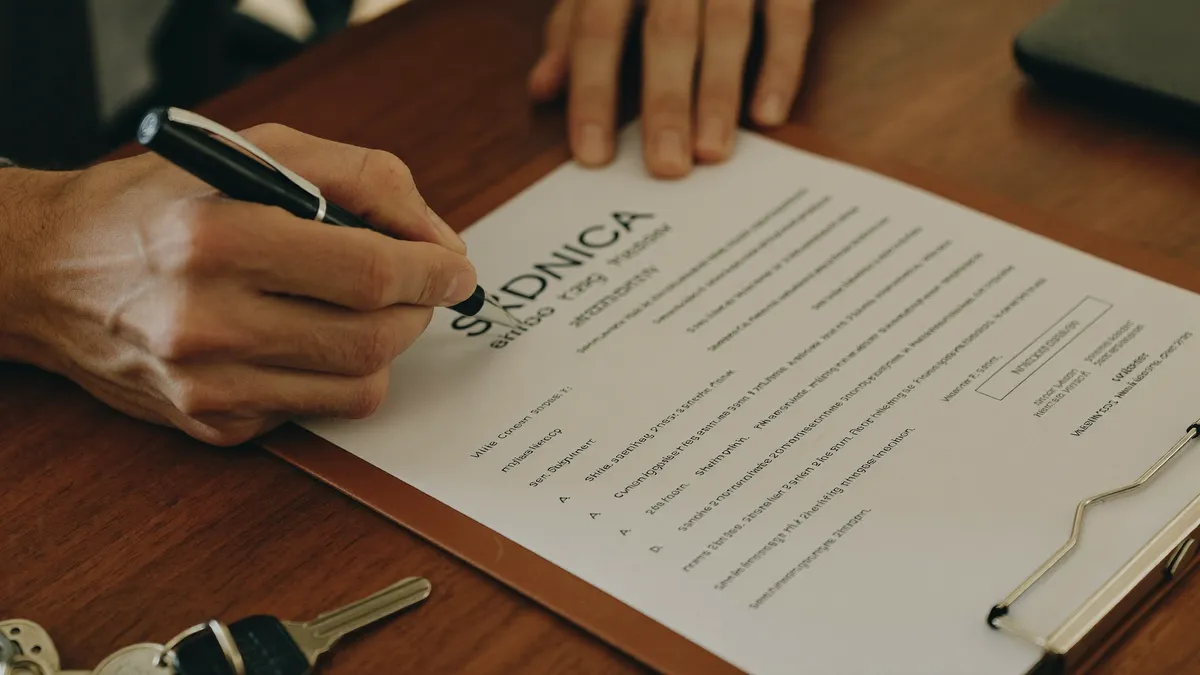
 Yes, but in a narrower scope than many people think. The occasional lease agreement itself does not have to be an akt notarialny — ordinary written form is enough, and that under pain of invalidity. An akt notarialny is needed for one annex: the tenant’s statement of voluntary submission to enforcement, in which they undertake to vacate and hand over the unit by the deadline indicated in the owner’s demand. That statement is based on art. 777 § 1 point 4 of the Code of Civil Procedure, and without it the agreement does not have the status of an occasional lease — we describe the full construction in the guide to najem okazjonalny.
The cost is capped by statute: the notary’s remuneration for this statement may not exceed 1/10 of the minimum wage for work. Since 1 January 2026 — with a minimum wage of PLN 4,806 — that is at most PLN 480.60 net plus 23% VAT, i.e. around PLN 591 gross. In practice many notarial offices charge PLN 200–400; on top of that come certified copies of the deed, usually PLN 6–12 per page. Customarily the tenant pays, but the parties may agree otherwise — it is worth writing that into the agreement explicitly.
How do substitute premises work and what if the tenant loses them?
 The tenant indicates another unit in which they will be able to live in the event of enforcement of the obligation to vacate the flat — most often it is the flat of their parents or another close person. Attached to the agreement is a statement by the owner of that unit consenting to the tenant and the people living with them residing there. At the landlord’s request, the signature under that consent should be notarially certified — a cost of around PLN 30–50.
Without the full set of three annexes — the notarial statement, the indication of the premises and the consent of its owner — the construction of najem okazjonalny does not work. The “mid-tenancy” scenario also matters: if the tenant loses the possibility of living in the indicated premises (e.g. the parents sell the flat), they have 21 days from learning of it to indicate a new address and provide a new consent (art. 19a para. 3). If they fail to do so, the owner may terminate the agreement with a notice period of at least 7 days (art. 19d para. 5).
Does the agreement have to be reported to the tax office?
 Yes — and it is the owner’s obligation, not the tenant’s. In accordance with art. 19b para. 1 of the act, the owner reports the conclusion of the agreement to the head of the tax office competent according to their own place of residence (not according to the address of the rented unit) within 14 days of the day the tenancy starts. The deadline runs from the handover of the unit, that is in practice from handing over the keys, and not from the date the agreement was signed.
There is no official form — a letter with the parties’ details, the address of the unit and the start date of the tenancy is enough. The report is free of charge; it can be filed in person, by registered post or electronically. At the tenant’s request the owner must present confirmation of the report. The consequence of neglecting it is serious: without the report art. 19c and 19d do not apply, so the owner loses the simplified enforcement route and is left with an ordinary fixed-term lease.
How much is the tax on najem okazjonalny?
The report under art. 19b does not replace tax settlements — these are two separate obligations. Since 2023 private rental has been settled exclusively under the ryczałt od przychodów ewidencjonowanych, and in 2026 the rates remain unchanged:
- 8.5% of revenue up to PLN 100,000 a year,
- 12.5% on the excess above PLN 100,000.
Example: with rent of PLN 3,000 a month the annual revenue is PLN 36,000, and the ryczałt PLN 3,060, that is PLN 255 a month. The tax is paid every month (or quarterly, if you meet the conditions) by the 20th day of the following month into your own individual tax micro-account, and after the end of the year a PIT-28 return is filed. We described the details of the rates and deadlines in the article on the ryczałt on rental income.
What does the owner really gain?
The difference shows itself when the agreement has ended and the tenant does not want to move out. Instead of eviction proceedings, which can drag on for years, the procedure looks like this:
- The owner serves a written demand to vacate the unit with an officially certified signature, setting a deadline of no less than 7 days from service (art. 19d para. 2–3).
- Once the deadline has passed without effect, they file with the court an application for an enforcement clause to be attached to the akt notarialny; they enclose the demand together with proof of service, a document confirming legal title to the unit and confirmation of the report to the tax office.
- With the clause, they refer the case to a bailiff, who carries out enforcement to the indicated substitute premises.
The differences side by side:
| Situation | Najem okazjonalny | Ordinary lease |
|---|---|---|
| Route to vacating the unit | Enforcement clause on the akt notarialny, then a bailiff | Court eviction proceedings, often over a year |
| Right to social housing | Not available | May be available |
| Protection period 1 November – 31 March | Does not apply | Applies |
| Maximum deposit | Six times the rent | Twelve times the rent |
What are the limits of this agreement?
Najem okazjonalny is not a gateway to doing whatever you like. A few hard frames:
- the landlord may only be a natural person who does not conduct business activity in the field of renting out premises;
- the agreement must be concluded for a fixed term, of at most 10 years;
- the deposit may not exceed six times the monthly rent (art. 19a para. 4); market practice settles on one or two times the rent — we write about the rules for its return in the article on tenants’ rights and the deposit;
- early termination by the owner is possible only in the statutory cases — among others, rent arrears covering at least three full payment periods after a written warning and the setting of an additional month for payment, subletting without consent, or using the unit in a manner contrary to the agreement.
Should the tenant be afraid of signing at the notary?
No, provided they understand what they are signing. The statement of submission to enforcement concerns only the obligation to vacate the unit after the agreement ends — it does not take away the right to go to court in disputed matters, e.g. over the settlement of the deposit or of improvements. For the tenant, a full set of documents usually means an owner who acts lawfully: they report the agreement, they pay the tax, and the terms — the rent, the metered charges, the deposit and the rules for its return — are written down precisely, rather than agreed “on someone’s word”. For tenants who are still looking for a place to live, we explain every annex before the visit to the notary — we describe the scope of rental help for tenants separately.
At allproperty we prepare the draft najem okazjonalny agreement and its report to the tax office, coordinate the making of the tenant’s notarial statement and make sure that none of the three annexes is missing — and we explain these documents to the tenant in plain language, including when they do not speak Polish. If you are renting out a flat in Warszawa and want to go through this process without formal stumbles, write to us — for the owner, letting a flat under Start costs 70% of one month’s rent, once, and Full management — 8% of the rent per month (only for months with a tenant) plus 2% into a small-repairs fund, which remains your money; you will find the scope of both models in the for flat owners section. Do you have a doubt about one of the annexes or about the reporting deadline, and it has come up in the evening or at the weekend, just before signing the agreement? We work 24/7 — call at any hour: +48 666 866 468.
Common questions
How much does the notary cost with najem okazjonalny in 2026?
The fee for the tenant's statement of submission to enforcement is capped by statute at 1/10 of the minimum wage. Since 1 January 2026 that is at most PLN 480.60 net, i.e. around PLN 591 including 23% VAT. In practice most notarial offices charge PLN 200–400, and certified copies of the deed cost PLN 6–12 per page.
Does a najem okazjonalny agreement have to be an akt notarialny?
No. The agreement itself only requires ordinary written form, on pain of invalidity, and is concluded for a fixed term of at most 10 years. The form of an akt notarialny (notarial deed) is required for one annex only: the tenant's statement of voluntary submission to enforcement, based on art. 777 § 1 point 4 of the Code of Civil Procedure.
By what deadline does najem okazjonalny have to be reported to the tax office?
The owner has 14 days from the day the tenancy starts, counted from the handover of the unit (handing over the keys), and not from the signing of the agreement. The report is filed with the head of the tax office competent for the owner's place of residence and is free of charge. Without the report, the simplified enforcement under art. 19c and 19d of the act does not work.
What tax do you pay on najem okazjonalny in 2026?
Private rental is settled exclusively under the ryczałt od przychodów ewidencjonowanych (the lump-sum tax on recorded revenue): 8.5% up to PLN 100,000 of revenue a year and 12.5% on the excess — the rates apply unchanged in 2026 as well. With rent of PLN 3,000 a month the ryczałt is PLN 255 a month, payable by the 20th day of the following month; the annual PIT-28 return is filed once a year.
What happens if the tenant loses the substitute premises?
The tenant has 21 days from learning that they have lost the possibility of living in the indicated premises to give a new address and provide the consent of its owner (art. 19a para. 3). If they fail to do so, the landlord may terminate the agreement with a notice period of at least 7 days.