Najem okazjonalny — what it gives the owner and the tenant? A simple guide
Najem okazjonalny in Warszawa: the mandatory annexes, the notary's cost, the report to the tax office and the deposit. A guide for both sides of the contract.

Najem okazjonalny (occasional lease) is a fixed-term flat rental agreement (for a maximum of 10 years), concluded in writing by an owner who is a natural person, with three mandatory annexes — including the tenant’s statement of submission to enforcement in the form of an akt notarialny (notarial deed). It is governed by art. 19a–19e of the act of 21 June 2001 on the protection of tenants’ rights. The notary’s cost is capped by statute at 1/10 of the minimum wage: with PLN 4,806 gross in 2026 that is at most PLN 480.60 net (around PLN 591 including VAT), and the whole package with certified copies usually comes to PLN 450–700 in Warszawa notarial offices. The owner must report the agreement to the tax office within 14 days of the tenancy starting — without that, they lose the simplified enforcement route. The deposit may amount to at most six times the rent, and the tax is the ryczałt (lump-sum tax on recorded revenue) of 8.5% of revenue (12.5% on the excess above PLN 100,000 a year). For the tenant — including a foreigner — this is a safe construction: it protects against termination “just because” and provides for the deposit to be returned within a month. Below we explain the details — the position as of August 2026.
If you would rather not search on your own, we offer help finding a rental apartment.
What is najem okazjonalny?
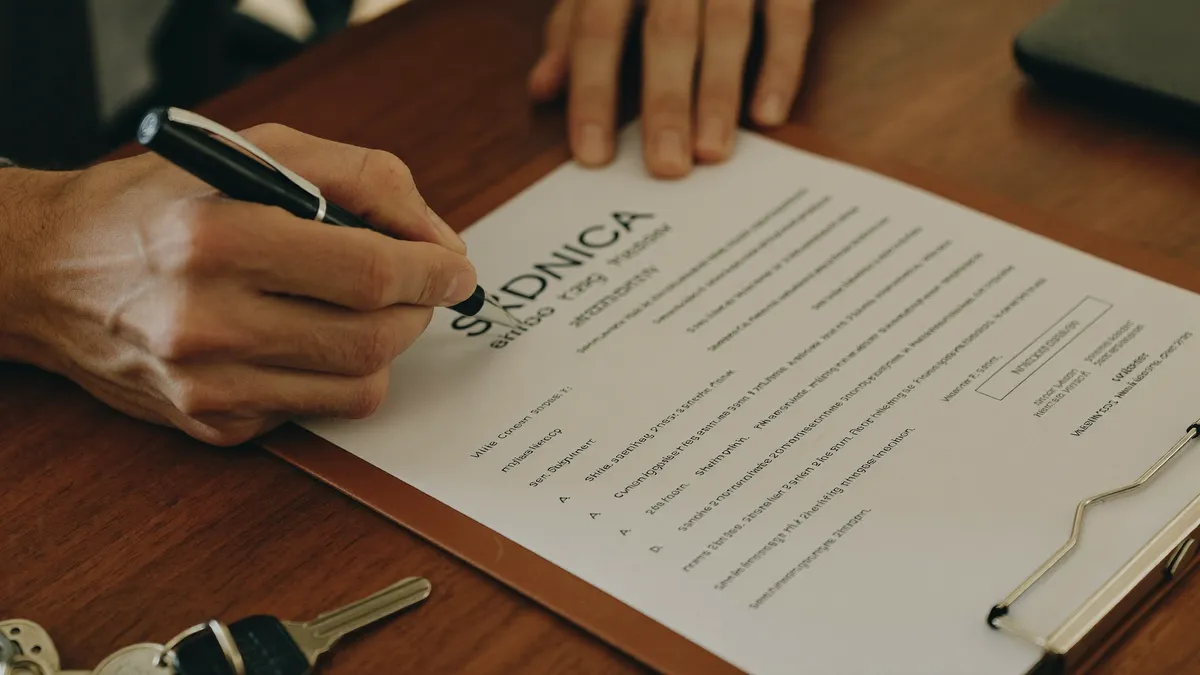
The definition is set out in art. 19a para. 1 of the act: it is an agreement for the lease of a residential unit whose owner is a natural person and does not conduct business activity in the field of renting out premises. The agreement must be concluded for a fixed term, of at most 10 years, and in written form on pain of invalidity — oral arrangements have no force here. If the landlord is a company, a different construction applies: najem instytucjonalny (institutional lease).
Importantly, the agreement itself does not require the form of an akt notarialny. Only one of the annexes goes to the notary, and we come to it in a moment.
Which annexes are mandatory under najem okazjonalny?
In accordance with art. 19a para. 2 of the act, three documents are attached to the agreement:
- The tenant’s statement of submission to enforcement — in the form of an akt notarialny. In it the tenant undertakes to vacate and hand over the unit by the deadline indicated in the owner’s demand. This is the only document that must be drawn up by a notary.
- Indication of substitute premises — the tenant gives the address of a flat to which they could move out in the event of enforcement. Ordinary written form is enough.
- The consent of the owner of the substitute premises for the tenant and the people living with them to reside there — also in writing; at the landlord’s request, with a notarially certified signature.
An important detail: if the tenant loses the possibility of living in the indicated premises (e.g. the owner of the “backup” address sells the flat), they have 21 days to indicate a new one. Without that, the landlord may terminate the agreement with a notice period of at least 7 days.
How much does the notary cost with najem okazjonalny?

The act limits the notary’s remuneration for the statement of submission to enforcement to 1/10 of the minimum wage for work. With a minimum wage of PLN 4,806 gross in 2026, that gives at most PLN 480.60 net, i.e. around PLN 591 including 23% VAT; on top of that come the certified copies (PLN 6 net per page). In practice, in Warszawa notarial offices the whole package usually comes to between PLN 450 and PLN 700 — the position as of August 2026.
Who pays? The act does not settle this — most often the tenant takes on the cost, but the parties may agree otherwise, e.g. to split it in half.
How and when do you report the agreement to the tax office?
The owner is obliged to report the conclusion of the agreement to the head of the tax office competent for their place of residence within 14 days of the day the tenancy starts (art. 19b para. 1) — what counts is the date the unit is handed over, not the date the agreement is signed. The report is free of charge and requires no form: a letter with the parties’ details, the address of the unit and the start date of the tenancy is enough, submitted in person, by post or through e-Urząd Skarbowy (the online tax office).
Without that report the agreement loses its most important asset — the simplified enforcement route — and works like an ordinary lease. Tenant: you have the right to demand confirmation of the report from the owner; it is worth doing so.
What does the owner gain?
Real protection in case the occupant does not want to move out once the agreement ends. The procedure looks like this: the owner serves a written demand to vacate the unit (with an officially certified signature), setting a deadline of no less than 7 days. If that deadline passes without effect, they file an application with the court for an enforcement clause to be attached to the akt notarialny — without a years-long eviction trial. The application is accompanied by the demand together with proof of service, a document confirming legal title to the unit and confirmation of the report to the tax office.
In addition, the deposit here may amount to up to six times the monthly rent — with rent of PLN 4,000 that is theoretically as much as PLN 24,000, although on the Warszawa market in 2026 the standard remains one or two times the rent. We write more broadly about the rules for its return and the permissible deductions in the article on the deposit and tenants’ rights.
What does the tenant gain?
Contrary to the common view — quite a lot. A fixed-term agreement means the owner cannot terminate it “because they changed their mind”: early termination is possible only in the cases described in the act or in the agreement, e.g. rent arrears covering at least three full payment periods — and only after a written warning and the setting of an additional one-month deadline for payment. The deposit is returned within a month of the unit being vacated, once the claims have been settled. If you are still looking for a flat, we describe the whole rental process from the tenant’s side separately — from viewing the unit to collecting the keys and the handover report.
A comparison of the most important parameters (the legal position as of 2026):
| Element | Najem okazjonalny | Ordinary lease |
|---|---|---|
| Duration | fixed term only, max. 10 years | fixed or indefinite term |
| Maximum deposit | six times the rent | twelve times the rent |
| Report to the tax office | mandatory, 14 days | no such obligation |
| Enforcing the vacating of the unit | enforcement clause for the akt notarialny | court eviction proceedings |
A practical bonus: a tenant ready to sign an occasional lease is more credible in the eyes of owners — it is easier to obtain good terms and a flat at all, something foreigners in Warszawa feel especially strongly.
How do you settle the tax on najem okazjonalny?
Since 2023 the only form of taxation of private rental is the ryczałt od przychodów ewidencjonowanych (the lump-sum tax on recorded revenue): 8.5% of revenue up to PLN 100,000 a year and 12.5% on the excess. With rent of PLN 3,500 a month the owner will pay PLN 297.50 of ryczałt per month, and will file the annual return on the PIT-28 form by 30 April of the following year. The “occasional” form itself does not change the tax rates — it only changes the obligation to report the agreement within 14 days. We have gathered the rates, deadlines and settlement examples in the guide to the ryczałt on rental income.
What to remember before signing?
A short checklist for both sides:
- check that the address in the agreement and in the akt notarialny matches the flat you viewed;
- take care of the protokół zdawczo-odbiorczy (handover report) with photos and meter readings;
- make sure all the oral arrangements have made it into the agreement — written form applies;
- tenant: indicate genuine substitute premises and remember the 21 days for indicating new ones should you lose them;
- owner: keep to the 14-day deadline for the report to the tax office and give the tenant confirmation of it.
At allproperty we prepare the draft najem okazjonalny agreement, arrange the tenant’s appointment at the notary and explain every point of the agreement — in Polish, Russian or Ukrainian. For the owner, letting a flat with us under Start costs 70% of one month’s rent, once, and Full management — 8% of the rent per month (only for months with a tenant) plus 2% into a small-repairs fund, which remains the owner’s money; we describe the scope of both models of support for flat owners on a separate page. If you are planning to rent out a flat in Warszawa, or you have just received an occasional lease agreement to sign — get in touch, we will go through it together. Does a clause raise doubts in the evening or just before a weekend appointment at the notary? We work 24/7 — call +48 666 866 468 and we will go through the agreement straight away, over the phone.
Common questions
How much does najem okazjonalny cost at the notary in 2026?
The fee for the statement of submission to enforcement is capped by statute at 1/10 of the minimum wage — with PLN 4,806 gross in 2026 that is at most PLN 480.60 net, i.e. around PLN 591 including VAT. With the certified copies, the whole package in Warszawa notarial offices usually costs PLN 450–700. The act does not say who pays — most often the tenant, or the parties split it in half.
Does a najem okazjonalny agreement have to be in the form of an akt notarialny?
No. The agreement itself only requires ordinary written form, on pain of invalidity, and a fixed term of at most 10 years. An akt notarialny (notarial deed) is needed for one annex only — the tenant's statement of submission to enforcement. Indicating the substitute premises and the consent of its owner may be in ordinary written form — the legal position as of 2026.
By what deadline must the owner report a najem okazjonalny to the tax office?
Within 14 days of the day the tenancy starts — what counts is the date the unit is handed over, not the date the agreement is signed. The report to the head of the tax office competent for the owner's place of residence is free of charge and requires no form. Without it, in 2026 the agreement loses the simplified enforcement route and works like an ordinary lease.
How large can the deposit be under najem okazjonalny?
At most six times the monthly rent — with rent of PLN 4,000 that is up to PLN 24,000, although on the Warszawa market in 2026 the standard remains one or two times the rent. The deposit is returned within a month of the unit being vacated, after the owner's claims have been settled. Under an ordinary lease the limit is higher: twelve times the rent.
Is najem okazjonalny safe for the tenant?
Yes. A fixed-term agreement protects against termination without a reason — the owner may end it early only in the cases set out in the act, e.g. arrears covering three full payment periods and after an additional one-month deadline for payment. A tenant ready to sign such an agreement is also, in Warszawa in 2026, more credible in the eyes of owners.