Ranking of Warszawa districts by rental prices in 2026
Ranking of the 18 Warszawa districts by rental prices in 2026: full table in PLN/month, the priciest and cheapest locations, and how the metro moves rents.

Renting a flat in one and the same Warszawa can cost PLN 2,900 or PLN 6,400 a month — it all depends on the district. According to listing portal data, as of August 2026, the most expensive is Wilanów (an average of about PLN 6,400) and the cheapest is Rembertów (about PLN 2,900). The rest of the city sits between those two poles: Śródmieście and Wola hold the upper part of the table, Mokotów and Żoliborz occupy the middle of the higher band, and Białołęka, Bielany and Targówek — the middle of the lower one. Below you will find a full listing of all 18 districts with prices, an explanation of where the differences come from, and tips on how to read such a comparison so that the average alone does not mislead you. This text focuses solely on the district-to-district comparison — a general overview of the rental market across Warszawa, broken down into studios and two- and three-room flats, is in a separate article, How much does renting a flat in Warszawa cost in 2026.
How much does renting a flat cost in the individual districts of Warszawa?

The table below lists all 18 districts of Warszawa by average rent, based on data from listing portals (homerenty.pl, znajdznajem.pl), as of August 2026. The order reflects the real distribution of offers, not just the “from–to” prices found in individual listings.
| # | District | Average rent (PLN/month) | Indicative rate per m² |
|---|---|---|---|
| 1 | Wilanów | approx. PLN 6,400 | PLN 95–130 |
| 2 | Śródmieście | approx. PLN 5,500 | PLN 100–150 |
| 3 | Wola | approx. PLN 4,500 | PLN 85–115 |
| 4 | Wesoła | approx. PLN 4,250 | PLN 70–90 |
| 5 | Mokotów | approx. PLN 4,200 | PLN 90–140 |
| 6 | Żoliborz | approx. PLN 4,100 | PLN 95–130 |
| 7 | Ursynów | approx. PLN 3,700 | PLN 78–105 |
| 8 | Praga-Północ | approx. PLN 3,700 | PLN 75–105 |
| 9 | Włochy | approx. PLN 3,650 | PLN 80–100 |
| 10 | Wawer | approx. PLN 3,500 | PLN 65–90 |
| 11 | Ursus | approx. PLN 3,350 | PLN 72–95 |
| 12 | Praga-Południe | approx. PLN 3,300 | PLN 70–105 |
| 13 | Ochota | approx. PLN 3,300 | PLN 80–110 |
| 14 | Bemowo | approx. PLN 3,200 | PLN 72–98 |
| 15 | Targówek | approx. PLN 3,050 | PLN 63–85 |
| 16 | Bielany | approx. PLN 3,050 | PLN 68–95 |
| 17 | Białołęka | approx. PLN 3,000 | PLN 65–88 |
| 18 | Rembertów | approx. PLN 2,900 | PLN 65–85 |
Bear in mind that these are averages for a whole district — a two-room flat of a similar size in Śródmieście and in Białołęka can differ in rent by as much as PLN 2,000–2,500 a month, as of 2026.
Why are Wilanów and Śródmieście the most expensive?

Śródmieście pays a premium for location: the proximity of offices, universities and the M1 and M2 metro interchanges keeps vacancy there at a mere 2–3%, meaning flats let almost immediately. Wilanów, in turn, owes its high average to the structure of its building stock — apartment blocks and semi-detached houses with large floor areas dominate, so even at a lower rate per m² (PLN 95–130) the total rent comes out high. On top of that, Wilanów has no metro station today and none planned for the coming years — which shows that a high price does not always go hand in hand with good rail access. A similar mechanism pushes up the average in Żoliborz, where three-room flats in new developments reach PLN 7,000–11,000.
Which districts offer the lowest rents?
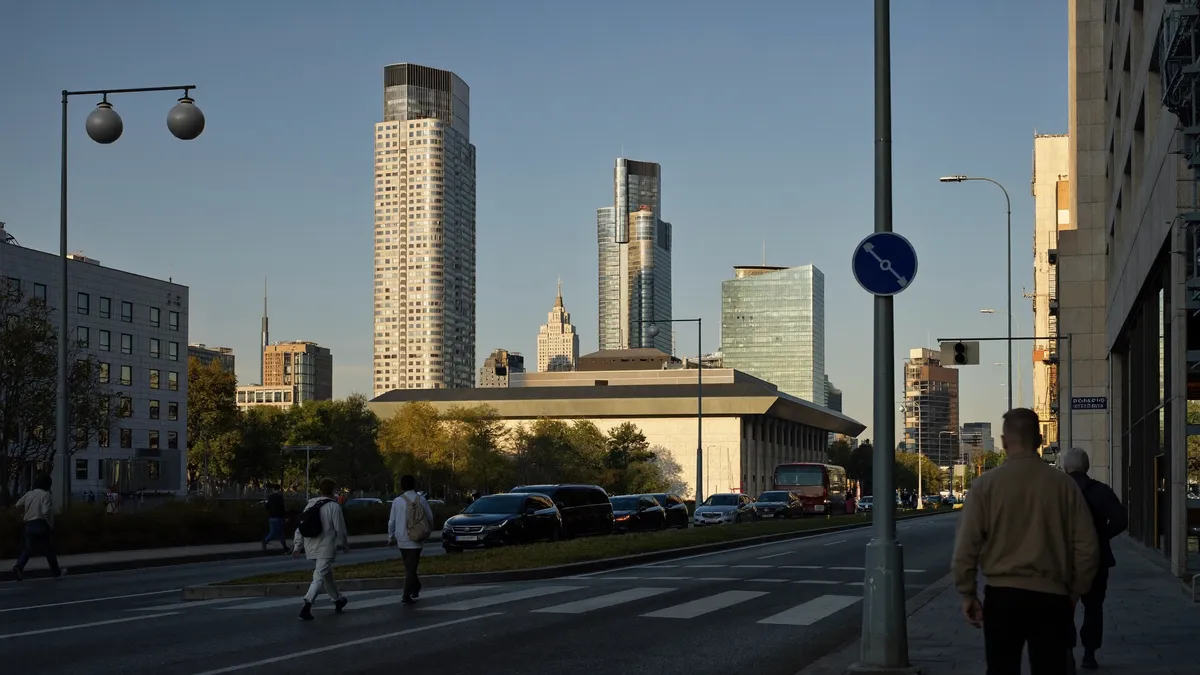
The lower part of the ranking is occupied by outlying districts: Rembertów, Białołęka, Bielany and Targówek. The common denominator is a longer commute to the centre, a lower density of offices nearby and a higher vacancy rate — in Białołęka and Targówek it reaches 7–12%, which gives tenants real negotiating leverage. Rembertów, as the cheapest district of Warszawa (about PLN 2,900 on average), benefits from the SKM commuter rail link, but still has neither a metro station nor a fast tram to the centre. If you are looking at a specific district from this group, separate guides to the offer and the infrastructure are available, for example for renting in Białołęka or renting in Targówek.
How does the metro affect rental prices in the individual districts?
Warszawa currently has two operating metro lines: M1 (Kabaty–Młociny, 21 stations, about 39 minutes end to end) and M2 (Bemowo–Bródno, 18 stations, about 33 minutes), as of 2026. M1 directly serves Ursynów, Mokotów, Śródmieście, Żoliborz and Bielany, and M2 — Bemowo, Wola, Śródmieście, Praga-Północ and Targówek. By the end of 2026 M2 is due to be extended westwards with the Lazurowa, Chrzanów and Karolin stations. The districts with no metro station at all — Wilanów, Białołęka and Wawer — show that the absence of a metro alone does not determine the price: in Wilanów the high standard of the buildings compensates for the missing rail link, while in Białołęka and Wawer it is the poorer commute that drags the average down. A full comparison of the districts by metro accessibility is in Warszawa districts with the strongest metro connections.
Price per m² or total price — what to look at when comparing districts?
The total price in the table above is convenient for a quick comparison, but it can mislead when you compare districts with a different mix of flats. An example: Wesoła and Praga-Południe have a similar rate per m² (PLN 70–90 and PLN 70–105 respectively), yet the average total rent in Wesoła comes out higher, because houses and larger flats dominate the offers there rather than studios. That is why, when making a real choice, it is always worth asking about the floor area of a specific offer and converting it into PLN per m² yourself, instead of relying solely on the district average. Another good practice is to compare several offers from a single district in the catalogue on the flats page — the real spread of prices can be considerable even within one street.
Where is renting more profitable for owners, and where for tenants?
From the owner’s point of view a higher rent in Śródmieście or Wola means higher monthly income, but also stronger competition on the standard of the finish. From the tenant’s point of view the districts in the middle of the table — Ursynów, Praga-Południe, Ochota — offer a sensible compromise between price and access by metro or tram. If you are planning to buy a flat to let, it is worth setting this ranking against the analysis of investment potential in Where to invest in a flat to let in Warszawa in 2026. More guidance for both sides of the transaction is in the sections for owners and for tenants.
How to choose a district for renting — what to consider beyond price?
The position in the price ranking alone should not be the only criterion. Before deciding, it is worth checking:
- The real commuting time to work or university at peak hours, not just the distance on the map.
- The level of the czynsz administracyjny (service charge to the building administration) and utilities — in 2026 this usually adds PLN 550–1,300 on top of the rent itself.
- The vacancy level in a given district — a higher share (Białołęka, Targówek) gives more room to negotiate the price.
- Plans for infrastructure expansion, for example metro line extensions, which over a few years can raise the appeal and the prices of an area.
The price comparison in the table above is a good starting point, but the final decision should always take individual priorities into account — work, the children’s school or lifestyle.
If after going through the table you are still hesitating between districts — for example whether to choose the pricier but well-connected Żoliborz or the cheaper Targówek with a longer commute — call us and we will advise on the basis of the current offer in a given location. allproperty works 24/7 on +48 666 866 468, so you can call both in the middle of a working day and in the evening after coming back from viewings.
Common questions
Which district of Warszawa is the most expensive to rent in?
According to listing portal data from August 2026 the most expensive is Wilanów, where the average rent reaches about PLN 6,400 per month, followed closely by Śródmieście with an average of about PLN 5,500. That high position follows from the large share of premium apartments and houses in those districts.
Which district of Warszawa has the lowest rents?
The cheapest is Rembertów, where the average rent in August 2026 was about PLN 2,900 per month. Białołęka, Bielany and Targówek are only slightly more expensive — in those districts the average rates fall within the PLN 3,000–3,100 range.
What is the difference in rent between the most expensive and the cheapest district of Warszawa?
The gap between Wilanów (about PLN 6,400) and Rembertów (about PLN 2,900) is more than PLN 3,500 per month, that is more than double the rate. As of August 2026 — for a two-room flat of a similar size that difference is often even sharper when converted into PLN per m².
Do districts without a metro always have lower rents?
Not always — Wilanów and Wawer have no metro station, and yet Wilanów is the most expensive district of Warszawa thanks to the high standard of its buildings and its location by the Vistula. On the other hand, the absence of a metro genuinely lowers prices in districts of a lower standard, such as Białołęka or Rembertów, as of 2026.
Is it better to compare districts by the price per m² or by the total rent?
It is worth looking at both indicators at once — the price per m² (PLN 65–150 per m² in 2026, depending on the district) shows the real cost of floor space, while the total price also reflects the typical size of the offers in a given location. A district with a lower rate per m² may have a higher total rent if larger flats dominate there.