Warsaw districts close to parks and nature
Wawer, Wilanów, Bielany and Białołęka are the Warszawa districts closest to nature – forest, river and parks outside the window. Prices per m², commute and 2025 facts.

Four Warsaw districts offer genuine proximity to nature without leaving the city: Wawer borders the Mazowiecki Park Krajobrazowy (15,710 ha), Bielany has the Las Bielański reserve on its edge (around 130 ha of forest), Wilanów offers Jezioro Wilanowskie and the palace park, and Białołęka – boulevards and beaches on the Vistula. Prices in 2025 differ considerably: from around PLN 12,300–12,500/m² on the secondary market in Wawer and Białołęka, through around PLN 15,500/m² in Bielany, up to around PLN 17,300/m² in Wilanów (asking-price data, dobralokacja.pl). These are not districts cut from one cloth – one gives you forest and quiet, the second a river and bikes, the third a metro right next to a reserve, the fourth a palace and a lake. Below are the specific differences, prices and commutes.
Wawer and the Mazowiecki Park Krajobrazowy – how much does a flat near the forest cost?
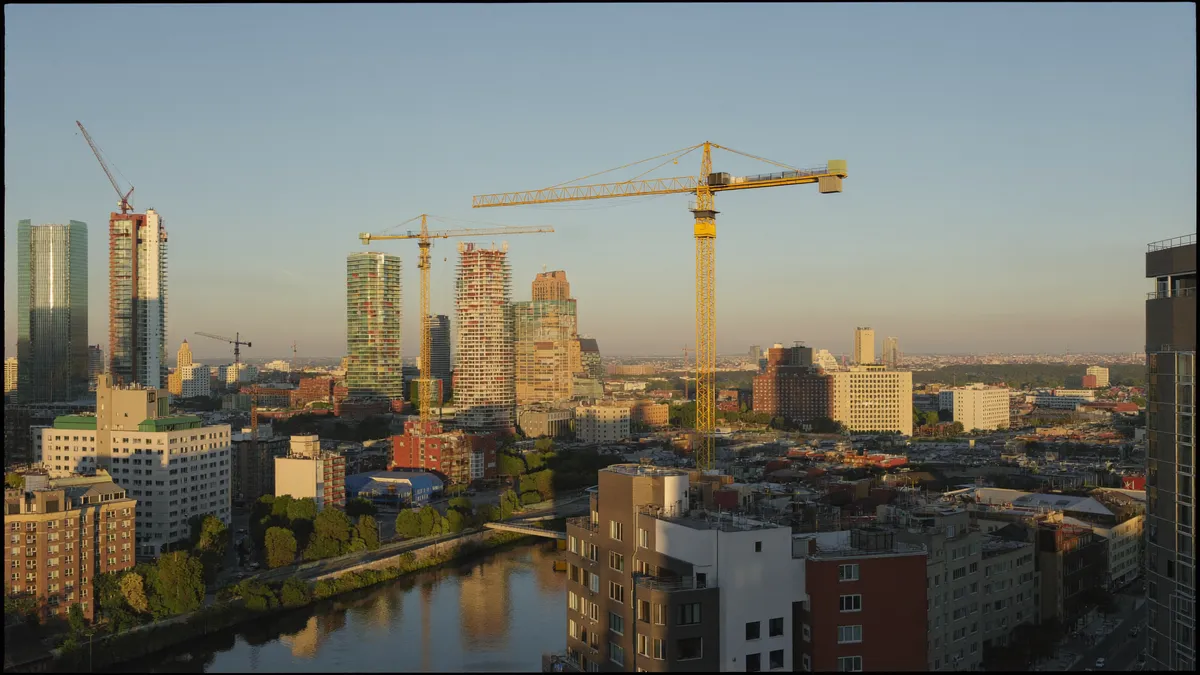
Wawer is the largest district of Warszawa by area, and its eastern and southern parts lie within the Mazowiecki Park Krajobrazowy im. Czesława Łaszka – 15,710 ha of forests and valleys stretching from Marysin Wawerski all the way to Otwock and Karczew. Wawer itself also contains the King Jan Sobieski reserve (113.56 ha, established in 1952) – one of the few fragments of old oak stands in the city and an important breeding ground for songbirds. Prices in 2025 stand at around PLN 12,500/m² on the secondary market and around PLN 13,500/m² on the primary market – one of the lowest rates in the city for a district with such access to nature. You should know, however, that since October 2025 the modernisation of railway line no. 7 on the Wawer–Otwock section has been under way (rebuilding of the Anin, Międzylesie, Radość, Miedzeszyn and Falenica stations), traffic periodically runs on a single track with ZTM replacement buses, and completion of the main works is planned for spring 2027.
Wilanów: a lake, a palace park and fields – how does it differ from other villa districts?

Wilanów combines villa development with real nature: Jezioro Wilanowskie (13.47 ha of a Vistula oxbow) lies directly behind the Wilanów Palace, surrounded by Park Wilanowski and the Morysin reserve. In the summer season there is a supervised bathing area, a kayak and boat rental and a free ferry connecting the Wilanów beach with the Romantyczna beach in Wawer. Along the Vistula itself run wild riverside paths through meadows and woods, and the area around Vogla street is one of the more relaxing cycling routes in the city. This is what sets Wilanów apart from other green districts – here proximity to nature is combined with a historic UNESCO complex, not just with a forest or a river on their own. Prices in 2025 are among the highest of the districts described here: around PLN 17,300/m² on the secondary market and around PLN 22,000/m² on the primary market.
Bielany and Las Bielański – how close to nature can you live in the city?

Las Bielański is a nature reserve established in 1973, a remnant of the medieval Mazovian Forest, covering around 130 ha (the whole woodland area is 151.82 ha). Elm-ash riparian forest grows there with oaks several hundred years old, and the site takes in four terraces of the Vistula escarpment with a viewpoint over left-bank Warszawa. Since 2016 the reserve has been formally open to walkers along marked paths, and since 2011 it has also been protected as a Natura 2000 area. What makes Bielany unique among the districts in this list is the combination of such a reserve with the metro – the M1 stations Marymont, Słodowiec, Stare Bielany, Wawrzyszew and Młociny lie practically on the edge of the forest. Asking prices in 2025 stood at around PLN 15,500/m² on the secondary market and around PLN 17,500/m² on the primary market.
Białołęka: the Vistula boulevards and the Ławice Kiełpińskie reserve – who is this district for?
Unlike Bielany or Wawer, Białołęka has no single large forest at its centre – its asset is a long, still partly wild bank of the Vistula. By the Północny bridge (im. Marii Skłodowskiej-Curie) there is the Białołęka beach, and along the river run cycle paths and boulevards, less developed than those in the centre but calmer for it. North of the built-up area lies the Ławice Kiełpińskie faunal reserve (88.26 ha within the borders of Warszawa, 803 ha in total including the part outside the city) – a breeding refuge for waterfowl and wading birds. It is exactly this contrast – dense new housing estates and a wild river bank right next to them – that distinguishes Białołęka from the other three districts, which have more “arranged” nature. Prices in 2025 are the lowest in this comparison: around PLN 12,300/m² on the secondary market and around PLN 13,500/m² on the primary market.
How do you get from these districts to the centre?
Transport accessibility differs strongly from district to district – it often decides more than the proximity of greenery itself.
| District | Main connection | Commute profile (2025) |
|---|---|---|
| Bielany | metro M1 (Młociny, Wawrzyszew, Stare Bielany, Słodowiec, Marymont) | the fastest and most reliable commute of the four districts |
| Wilanów | tram 14/16/19 to Miasteczko Wilanów, buses 116/180/519 | new tram route launched in 2024–2025, ultimately under 30 min to the centre |
| Wawer | SKM S1/S10, KM R7 (Anin, Radość, Międzylesie, Miedzeszyn, Falenica) | modernisation of line no. 7 until spring 2027, periodic single-track traffic and replacement buses |
| Białołęka | buses, tram to Winnica | no metro, the trip usually takes 30–45 minutes |
How much does a flat close to nature in Warszawa cost in 2025?
| District | Secondary market (PLN/m²) | Primary market (PLN/m²) |
|---|---|---|
| Białołęka | approx. 12,300 | approx. 13,500 |
| Wawer | approx. 12,500 | approx. 13,500 |
| Bielany | approx. 15,500 | approx. 17,500 |
| Wilanów | approx. 17,300 | approx. 22,000 |
Asking-price data for 2025, dobralokacja.pl. Transaction prices are sometimes lower than asking prices – it is worth checking the current offer in the flat catalogue.
Who will a district close to nature suit most?
- Families looking for quiet and space – Wawer and Białołęka, lower prices, more single-family houses and low-rise development.
- People who value a fast metro commute but want a forest by the house – Bielany.
- Buyers with a higher budget looking for prestige and history – Wilanów, with its lake and palace park.
- Cyclists and river lovers – Białołęka and Wilanów, both have boulevards and trails along the Vistula.
Before you decide, it is also worth checking the general level of flat prices in Warszawa in 2025 – this will give you a reference point for specific offers in these four districts.
What to look out for when buying a flat near a forest or a river?
Proximity to a reserve or a landscape park means additional restrictions – for example protection zones in which new development is harder, which can be an advantage (fewer developer projects next door) or a drawback (less new infrastructure). It is worth checking the local zoning plan for the plot and the building, and for flats close to the Vistula – the flood zone and the history of flooding in that particular spot. We described the whole purchase process, from the offer to the akt notarialny (notarial deed), step by step in the article on buying a flat in Warszawa.
If you are wondering whether nature is closer in Wawer, Bielany, Wilanów or Białołęka – the simplest way is to check on the spot, because each of these districts has a completely different character despite the shared slogan “close to greenery”. If you are considering a new development in one of these areas, it is worth starting with a review of flats from developers in Warszawa – on the primary market we do not charge the buyer a commission. The allproperty team is available 24/7, so if you want to arrange a viewing of a flat by Jezioro Wilanowskie, next to Las Bielański or closer to the Wawer forests – just call, also in the evening or at the weekend, at +48 666 866 468.
Common questions
Which Warsaw district is closest to a forest?
The closest real, protected forest within the city limits is in Bielany – the Las Bielański reserve covers around 130 ha (the whole woodland area is 152 ha) and borders directly on the buildings around the Marymont and Wawrzyszew metro stations. In Wawer, in turn, you live next to the Mazowiecki Park Krajobrazowy (landscape park) covering 15,710 ha.
How much does a flat in Wawer cost in 2025?
According to asking-price data from 2025, the average price on the secondary market in Wawer is around PLN 12,500/m², and around PLN 13,500/m² on the primary market (dobralokacja.pl). That is one of the lower rates in Warszawa despite the proximity of forests and a nature reserve.
Can you live close to water in Wilanów?
Yes – Jezioro Wilanowskie, an oxbow lake of the Vistula covering 13.47 ha, lies in Park Wilanowski just behind the palace. In summer there is a beach, a bathing area and a kayak rental there, and a ferry takes you to the other bank, to Wawer.
How do you get from Białołęka to the centre without a car?
Białołęka does not have a metro yet, so the backbone is the bus network and the tram to Winnica; the trip to the centre usually takes 30–45 minutes. In exchange, the district offers boulevards and a beach by the Północny bridge as well as a dense network of cycle paths along the Vistula.
Are there still rail disruptions in Wawer?
Yes, since October 2025 the modernisation of railway line no. 7 on the Wawer–Otwock section (stage IIb) has been under way; traffic runs on a single track with ZTM replacement transport, and completion of the main works is planned for spring 2027.